My Website Isn’t Driving Leads
Your website is where you should be driving leads to turn into paying customers. If it isn’t: read on to find out what you can do to increase leads.

Leads are what drive your business. And your website is ultimately where you’ll drive them (hopefully) to turn them into paying customers.
According to one study, 61% of marketers see lead generation as their biggest challenge. It underscores that the issue isn’t closing the sale but getting your business in front of them in the first place.
So, if your website isn’t driving leads, you’ve got a big problem turning your marketing spend into a profit. With that in mind, why might your website not be driving leads, and what can you do about it?
What it means to not get leads through your website
A website that doesn’t get leads isn’t doing what it’s supposed to do as a sales tool. Today, 53% of marketers are spending more than half of their budgets on lead-gen activities. If you’re one of those marketers, then your website isn’t an asset but a drain on our business.
When your website isn’t actively generating leads and, therefore, revenue, it could be due to any number of reasons. But the implications are massive, including:
· Your website might be driving traffic, but visitors aren’t staying or aren’t doing what you want them to.
· You’re not portraying your company as trustworthy or legitimate.
· Your site isn’t ranking on Google for your chosen keywords.
· Your site is ranking, but the visitors aren’t the right audience.
All this adds up to missed revenue opportunities. And it’s not an uncommon problem today. For example, 85% of B2B marketers can’t connect marketing performance to actual business outcomes. What that means is that firms are finding it difficult to translate leads into a positive ROI.
Why your website isn’t driving leads
Your website could be failing to drive leads for several reasons, including providing limited value, a poor user experience, or simple errors like not providing a call-to-action (CTA) or not optimising for mobile.
Just for context’s sake, average conversion rates for eCommerce hover between 2-3%, with top performers hitting 4% or more.
So, if you’re below this baseline, your site could have problems like:
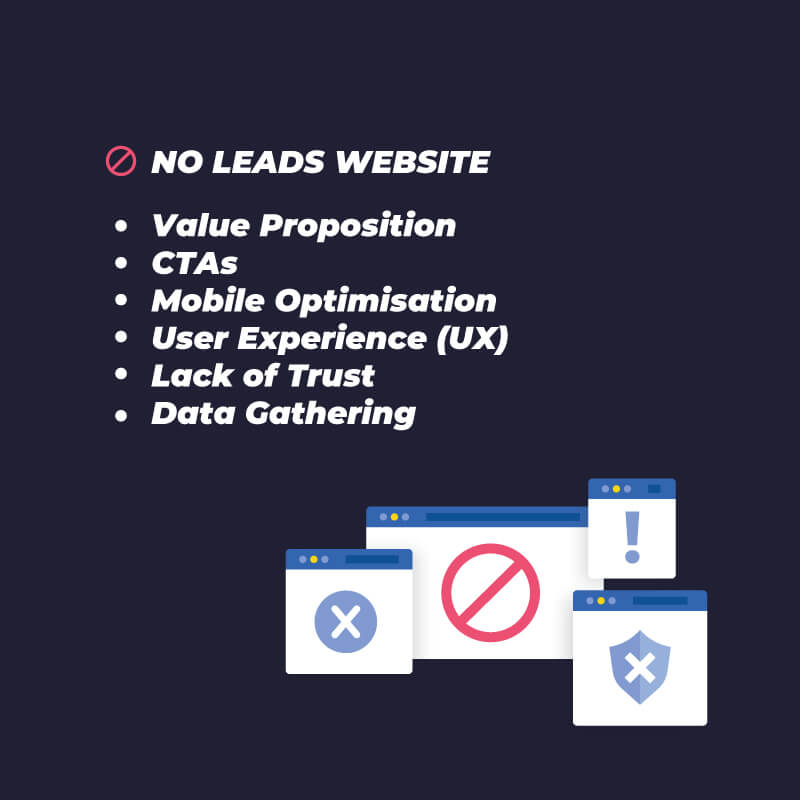
It takes just one of these issues to curtail the influence of your website and make it extremely difficult for you to generate leads, let alone take them all the way through your sales funnel.
What a website that drives leads looks like
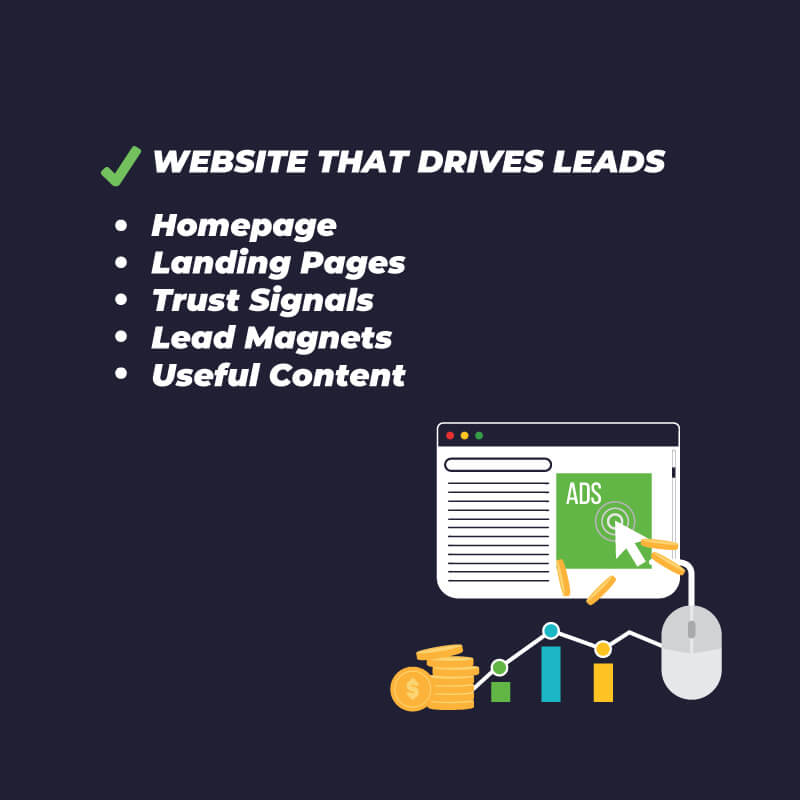
Websites will look and feel different for every firm in every industry. However, look closer, and you’ll see that every high-conversion website has the same elements. These include a benefits-driven homepage, dedicated landing pages, an easy-to-use layout, and a clear content strategy.
Let’s go through what a user might expect from start to finish:
Homepage – The homepage is all about the benefits of your company, product, or service. It’s optimised for mobile with easy navigation and a primary CTA positioned above the fold.
Landing Pages – Dedicated landing pages, which may be part of a particular marketing campaign, focus on a specific product or service. There’s no extra navigation menu and no CTA conflict. Each landing page is focused, minimalist, and concentrated on driving a particular action.
Trust Signals – Throughout your website, you have case studies, testimonials, and reviews, including links to your Google page, showing that you can be trusted as a company.
Lead Magnets – Your website provides value from the very first interaction via lead magnets. These could be eBooks, webinars, or something as simple as a free consultation.
Useful Content – Your content strategy is another form of direct value that helps create trust and build authority. It could consist of videos, educational blog posts, or any other resource that addresses audience problems and captures that search traffic.
Hitting these points is easier said than done, though. What works for one company won’t necessarily work for another.
This is why you can expect to implement rigorous A/B testing to determine what works and what you need to tweak to improve your results.
How we help with your website to drive more leads
Building a website that drives leads is a meticulous process requiring expertise and experience. You could go through a drawn-out trial-and-error process to get it right. Still, the reality is that high-conversion websites are built with a combination of technical SEO, content strategies, optimisation, and targeted PPC.
Learning and mastering all these things takes valuable time away from running your business and serving your customers. And there’s no guarantee that you’ll actually succeed. At Tao Digital Marketing, we optimise the user experience at every turn through approaches like:
· Tailored content strategies.
· Local search optimisation.
· Technical site improvements.
We do this by getting to know your business and your audience, so we can improve how your website performs for both potential leads and search engines. If you’d like to learn more about building a high-performance website that actually turns clicks into customers, get in touch with us today.